A cold or numb limb, an open wound over a fracture, severe deformity, or weakness after a crash can signal more than a routine broken bone. You will learn which injuries need immediate trauma assessment, what clinicians do next, and how to judge whether a hospital can provide the imaging, surgery and follow-up complex injuries require.
Key takeaways
- Go to emergency care for heavy bleeding, an open fracture, numbness, or a cold blue limb.
- Do not straighten a deformed joint; support it in the position found.
- Tell the trauma team how the injury happened, when it occurred, and what moved abnormally.
- Return for review if pain, swelling, numbness, fever, or wound drainage worsens.
Which injury signs mean you need emergency trauma care now?
Call emergency services or go to an emergency department now for any of these findings. They can signal an injury requiring an orthopedic trauma surgeon rather than a clinic appointment.
| Finding | Why it is urgent | Immediate action |
|---|---|---|
| Open fracture, exposed bone, or wound that may reach the fracture | Infection and tissue damage can progress quickly | Cover with a sterile dressing and seek emergency care |
| Uncontrolled bleeding, expanding swelling, or a cold or pale limb | Arterial injury or dangerous pressure may be present | Apply pressure around, not directly over, exposed bone |
| Numbness, paralysis, severe deformity, or an irreducible dislocation | Nerves, blood vessels, skin, or the joint may be threatened | Keep the limb still in its found position |
| Pelvic injury, or spinal tenderness with weakness, poor coordination, or bladder or bowel changes | Internal bleeding or spinal-cord injury can coexist | Keep the person still and do not encourage walking |
Suspect acute compartment syndrome when pain is out of proportion, pain increases when muscles are passively stretched, or the limb becomes tense and swollen with new numbness or weakness. A pulse can remain present early; do not wait for it to disappear.
Tell responders when the injury happened and whether it involved a crash, fall, crush, twist, or penetrating object. Do not straighten a limb, push bone back, reduce a dislocation, remove an embedded object, or repeatedly move a possibly injured spine.
Immobilise the limb as found, remove rings and tight footwear before swelling increases, and avoid food or drink when surgery is possible unless emergency clinicians advise otherwise.
Which injury patterns and mechanisms commonly need trauma expertise?
A stable, closed fracture with good alignment and intact nerves and blood flow may suit routine fracture care or non-operative treatment. Specialist trauma assessment is warranted when the pattern threatens joint function, alignment, soft tissue, or limb survival.
| Injury pattern | Why trauma expertise matters |
|---|---|
| Comminuted, displaced, unstable or intra-articular fracture | Multiple fragments, poor alignment or joint-surface damage can cause stiffness, post-traumatic arthritis or loss of function. |
| Pelvic fracture or acetabular fracture | Bleeding can occur inside the pelvis, while socket damage can destabilise the hip. |
| Multiple fractures, fracture-dislocation, tendon or ligament avulsion | These injuries require coordinated imaging, reduction, fixation or soft-tissue repair. |
| Crush injury, open injury, or nerve or vessel damage | Muscle death, infection, loss of sensation or impaired blood flow can develop beneath an apparently intact skin surface. |
High-speed road crashes, falls from height, crush incidents, penetrating wounds and sports collisions transfer more energy than a low-energy twist. They therefore prompt assessment for hidden fractures, spinal injury, abdominal or chest trauma, and damage to nerves and vessels.
A hip dislocation needs reduction as soon as safely possible because prolonged displacement can damage the femoral head’s blood supply. A posterior dislocation can also injure the sciatic nerve or fracture the acetabulum.
Suspected pelvic instability can cause major internal bleeding without visible blood; when indicated, place a pelvic binder over the greater trochanters, not around the abdomen.
Children need growth-plate assessment because modest deformity can still disturb later growth. Older adults with hip fractures need coordinated medical and orthopaedic care; correct anaemia, dehydration, anticoagulation problems or heart failure without indefinite delay. Walking, pain relief or a normal first X-ray does not prove the injury is minor.
How are serious bone and joint injuries assessed and treated?
Assessment starts with the skin, wound and limb circulation. Clinicians record pulses, colour, temperature, sensation and movement in a neurovascular examination, then repeat it after splinting or reduction. An open fracture receives sterile coverage, intravenous antibiotics, tetanus assessment and operative irrigation and debridement when indicated; do not repeatedly explore the wound.
A standard X-ray uses multiple views. A CT scan clarifies complex joint, pelvic, acetabular and fracture-dislocation patterns, while MRI is reserved for selected occult fractures or soft-tissue injuries. Suspected arterial damage can prompt ankle-brachial pressure measurement or CT angiography, even when a pulse remains palpable.
Treatment depends on alignment, stability, soft-tissue damage and the patient’s overall condition:
- Splint or cast for protection while swelling settles or healing progresses.
- Closed reduction for a displaced joint or fracture, followed by another neurovascular examination.
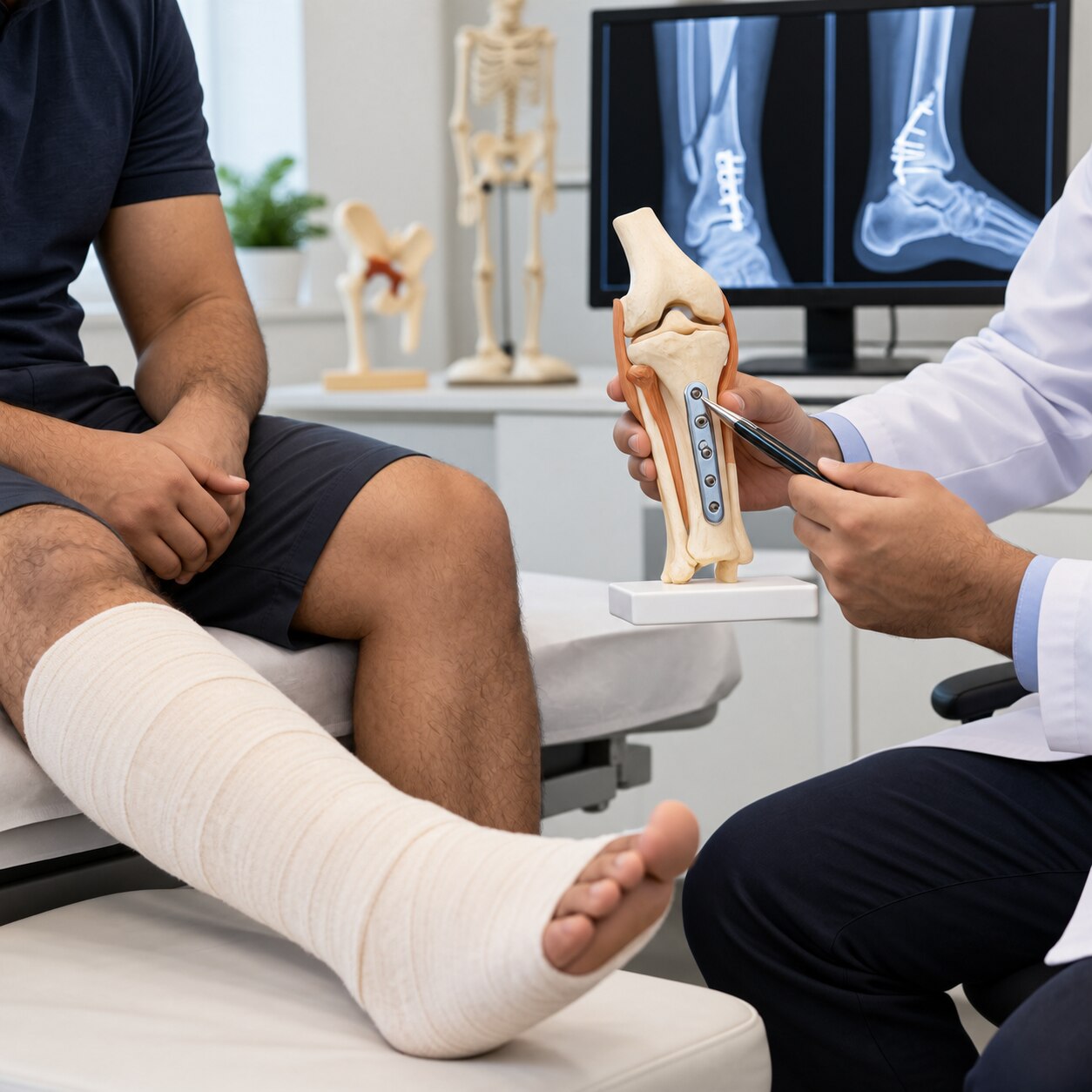
- Internal fixation with plates, screws or nails when alignment needs stable support.
- Ligament repair, observation or temporary external fixation when the injury pattern or soft tissues require it.
The first treatment is not always the final operation. Surgeons may delay definitive fixation for swelling, fracture blisters, contaminated wounds, medical stabilisation or soft-tissue recovery, balancing infection, blood loss, stiffness, healing time, repeat surgery and weight-bearing restrictions.
Delays or missed complications can cause blood-supply loss, nerve injury, infection, skin breakdown, malunion, nonunion, stiffness and post-traumatic arthritis. Suspected compartment syndrome generally requires urgent fasciotomy, not observation.
How should you choose a hospital or trauma specialist?
Choose immediate emergency care, not a second opinion or clinic slot, for a threatened limb, open fracture, unstable pelvis, spinal neurological symptoms or suspected compartment syndrome. A routine appointment fits an isolated bruise, a stable injury already assessed by a clinician, or chronic non-traumatic joint pain.
Ask whether the hospital provides:
- 24-hour emergency access, on-site X-ray and CT, and clinicians who can repeat neurovascular examinations
- Anaesthesia, operating-room support and blood bank access
- ICU capability or a documented ICU referral pathway
- Infection-control processes for open wounds, implants and surgery
- Rehabilitation and follow-up for wounds, bone healing, implant checks and changing weight-bearing restrictions
| Decision | Choose emergency trauma care | Routine appointment may fit |
|---|---|---|
| Hospital type | Orthopaedic trauma hospital or trauma service | Primary care, routine orthopaedics or rehabilitation |
| Injury status | Open fracture, unstable pelvis, threatened limb, spinal symptoms or suspected compartment syndrome | Bruise or stable injury already examined |
| Likely demands | Repeated imaging, admission, surgery, rehabilitation or staged operations | Examination, planned imaging and non-operative treatment |
| Timing | Immediate assessment; do not wait for a clinic slot | Booked review is reasonable when no red flags exist |
Take the injury time and mechanism, medicines, allergies, tetanus history, prior scans, medical conditions, and the time of the last food or drink. Plan for emergency travel, caregiver support, time away from work or school, prolonged driving limits and restricted weight-bearing.
In Panvel, Dhanvantari Hospital is one option to verify for emergency access, imaging, operative support, rehabilitation and follow-up before choosing it for complex trauma.
Related services
Accident and Trauma Surgery At Dhanvantari Hospital, Dr. Anand Upadhye and Dr. Sushant Upadhye provides expert Accident and Trauma Surgery treatment for patients suffering from... View service → |
Joint Replacement Surgery At Dhanvantari Hospital, Dr. Anand Upadhye and Dr. Sushant Upadhye provides advanced Joint Replacement Surgery for patients suffering from severe... View service → |
What should recovery look like, and when should you return?
Bone union, restored joint motion, return to work or sport, and implant removal are separate milestones. A single guaranteed recovery date is unrealistic, because swelling, soft-tissue damage, fracture complexity and healing speed affect the sequence.
- Follow your discharge plan for elevation, prescribed pain control, thrombosis prevention, splint or cast checks, wound review, physiotherapy and weight-bearing restrictions.
- Attend every review and repeat X-ray. The team checks alignment, implant position and delayed healing; children also need follow-up for growth-plate damage, which can appear months later.
- Do not resume unrestricted walking because pain has improved. Ask specifically when you may drive, bear weight, work, exercise and return for imaging or implant review.
- Keep the cast dry and report a cast that feels tight or causes numbness, increasing pain, swelling or colour change. Do not apply a tight homemade tourniquet for prolonged periods.
Seek urgent review for worsening or disproportionate pain, new numbness or weakness, a cold or pale limb, increasing swelling, fever, wound drainage, uncontrolled bleeding or a foul smell. These signs can indicate circulation problems, infection, nerve injury or compartment syndrome.
Persistent inability to bear weight, focal bone tenderness or worsening pain after a negative X-ray also warrants reassessment. Delayed healing and post-traumatic arthritis can affect function after treatment.
A staged procedure or later implant removal does not automatically mean the first treatment failed. It may reflect the soft-tissue condition, infection risk or the injury’s complexity.
Frequently asked questions
Which injury signs mean you need emergency trauma care now?
Seek emergency care for heavy bleeding, an open fracture, obvious deformity, loss of sensation or movement, or a cold, pale, blue, or pulseless limb.
Which injury patterns and mechanisms commonly need trauma expertise?
High-energy crashes, falls from height, crush injuries, multiple fractures, dislocations, pelvic or spinal injuries, and wounds near major blood vessels often need trauma expertise.
How are serious bone and joint injuries assessed and treated?
Clinicians check circulation, sensation, movement, skin and soft tissues, then use X-rays and, when needed, CT or MRI before splinting, reduction, wound care, or surgery.
How should you choose a hospital or trauma specialist?
Choose a hospital with emergency assessment, imaging, orthopaedic trauma expertise, surgical capability, anaesthesia, blood support, and rehabilitation access.
What should recovery look like, and when should you return?
Recovery depends on the injury and treatment; attend scheduled reviews and return promptly for worsening pain, swelling, numbness, fever, drainage, or a new loss of movement.
Related services
Fractures Treatment & Surgery At Dhanvantari Hospital, Dr. Anand Upadhye and Dr. Sushant Upadhye provides expert diagnosis and advanced treatment for all types of bone fractures,... View service → |
Arthroscopy and Sports Medicine Treatment Arthroscopy and Sports Medicine Treatment At Dhanvantari Hospital, Dr. Anand Upadhye and Dr. Sushant Upadhye provides advanced Arthroscopy and Sports Medicine treatments for patients... View service → |
Hand, Foot and Ankle Surgery At Dhanvantari Hospital, Dr. Anand Upadhye and Dr. Sushant Upadhye provides advanced diagnosis and surgical treatment for various hand, foot, and... View service → |
Paediatric Orthopedics Treatment Paediatric Orthopedics Treatment Dr. Anand Upadhye and Dr. Sushant Upadhye at Dhanvantari Hospital provides specialized paediatric orthopedics care for children with bone, joint,... View service → |