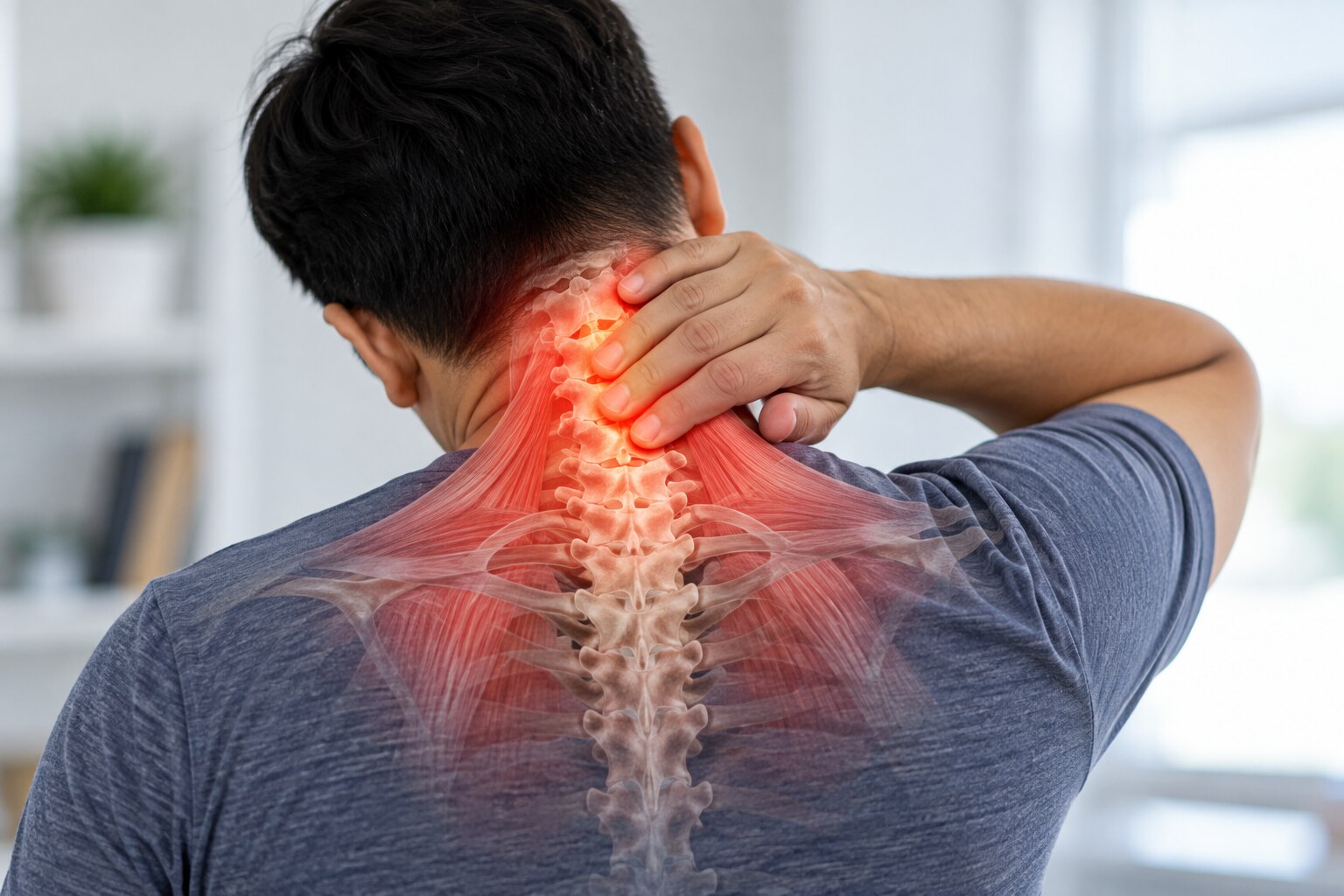
Neck pain can come from an irritated muscle, a facet joint, a disc, a compressed nerve or pressure on the spinal cord. By matching the pain’s location, quality, associated symptoms and time course, you can choose safer self-care and recognise when routine treatment is not enough.
Key takeaways
- Pain with movement often points to muscles, joints or ligaments.
- Arm weakness, clumsy hands, balance problems or bladder changes need prompt assessment.
- Use gentle movement and cold or heat during the first 48 hours.
- Seek urgent care after major injury or with worsening neurological symptoms.
Which neck structure is causing the pain pattern?
Pain location, movement and associated nerve symptoms help narrow neck pain causes, but they cannot identify the structure with certainty without an examination.
| Structure | Typical pattern | What makes it different |
|---|---|---|
| Muscle | Local aching, tightness and stiffness; movement feels restricted | Follows prolonged screen posture, awkward sleep, lifting, exercise or whiplash; strength, sensation and reflexes remain normal |
| Ligament | Focal pain after a sudden stretch or twist, often worse when the neck is loaded or moved | Ligament irritation feels deep or sharply localised rather than like broad muscle soreness; severe trauma requires assessment |
| Facet joint | Usually one-sided pain near the back of the neck, sometimes spreading to the shoulder or upper arm | Turning, extending or looking upward reproduces facet-joint pain; numbness and true weakness are not typical |
| Cervical disc | Deep neck pain that can spread toward the shoulder or arm | A bulging or irritated disc can hurt without nerve damage; pain below the shoulder, tingling or numbness raises concern for nerve-root compression |
| Nerve root | Burning, electric or shooting pain down the arm in a recognisable pathway | Weakness, altered sensation or reduced reflexes matter more than pain intensity |
| Spinal cord | Neck pain with hand clumsiness, dropping objects, balance trouble or leg stiffness | These signs need prompt medical assessment rather than treatment as a simple strain |
A scan showing a disc bulge, bone spur or narrowed space does not prove it causes your pain. The finding must match your symptoms and examination.
What symptoms suggest nerve or spinal-cord involvement?
Pain that stays in the neck and feels sore or tight is more consistent with mechanical pain than nerve involvement. Pain travelling below the shoulder into the arm, especially when burning, electric or shooting, raises concern for irritation of a nerve root.
Numbness or tingling in a band-like area, or weakness during particular movements, makes cervical radiculopathy a possibility; these clues can reflect nerve compression but cannot identify the cause alone.
Spinal cord compression is less about one painful spot and more about lost control in the hands or legs. Notice difficulty with buttons, writing, gripping or handling small objects; unsteady walking; stiff or heavy legs; or new bowel or bladder changes.
These symptoms can occur with cervical myelopathy and warrant prompt medical assessment instead of forceful stretching or neck manipulation.
Use the symptom pattern to judge urgency, not to label yourself:
- Local soreness and stiffness, with pain-limited movement but normal strength, sensation, balance and hand use: more compatible with mechanical pain.
- Radiating neck pain with arm tingling, numbness or weakness: arrange clinical assessment, especially if it is worsening or followed trauma.
- New clumsy hands, worsening balance, leg weakness or bowel or bladder changes: seek urgent medical care.
What should you do during the first 48 hours?
For likely mechanical pain, use gentle home care during the first 48 hours rather than complete bed rest. For neck strain treatment at home, keep ordinary activities within a comfortable range, avoid heavy lifting and sudden turning, and change position regularly.
| Measure | Use it when | How to use it safely |
|---|---|---|
| Cold pack | Pain began after a sudden strain or feels swollen and irritated | Wrap it in a cloth and apply for 15–20 minutes; never place ice directly on skin |
| Heat | Stiffness or muscle spasm is the main problem | Use a warm pack for 15–20 minutes; stop if pain or skin irritation increases |
| Gentle movement | Stiffness persists or movement feels restricted | Slowly turn and tilt your head within a comfortable range several times daily |
| Complete rest | Only during brief painful periods | Avoid prolonged bed rest or routine collar use, which can increase stiffness and weakness |
Choosing heat or cold for neck pain depends on which feels better; neither should numb the skin. Try pillow adjustment by keeping your head level with your spine, not pushed forward or tilted sideways. Improve screen posture by raising the screen to eye level and supporting your arms.
After the first day, gentle movement should replace prolonged rest if it does not increase arm pain, tingling or weakness. Stop self-care and seek medical assessment before manipulation or traction if pain followed significant trauma, or if you develop fever, worsening weakness, numbness, balance trouble or hand clumsiness.
When does neck pain need urgent or routine medical assessment?
Severe symptoms, neurological changes, or significant trauma call for emergency neck pain assessment rather than home observation. Neck pain red flags include new weakness, numbness spreading into an arm or leg, clumsy hands, trouble walking, leg stiffness, loss of bladder or bowel control, fainting, or confusion.
| Urgency | Warning signs | What to do |
|---|---|---|
| Emergency | Neck pain after accident with midline tenderness, reduced alertness, inability to rotate safely, new weakness, or abnormal sensation | Go to an emergency department; do not drive if movement or alertness is impaired |
| Prompt assessment | Fever and stiff neck, severe headache, vomiting, unexplained weight loss, severe night pain, marked spinal tenderness, or a history of cancer, immunosuppression, or intravenous drug use | Seek same-day medical advice, especially if symptoms are worsening |
| Planned orthopaedic appointment | Pain lasting several weeks, repeated episodes, arm pain with persistent tingling, or activity-limiting stiffness without emergency signs | Arrange an examination; persistent symptoms do not automatically mean you need an MRI |
Children need urgent assessment for neck pain with fever, severe headache, torticollis, drooling, difficulty swallowing or breathing, recent significant trauma, or neurological symptoms. Infection, airway disease, fracture, and spinal problems can look unlike a simple strain.
After a minor injury, worsening pain or new symptoms still justify review. A planned appointment at Dhanvantari Hospital can help match examination and imaging to the pattern instead of assuming every episode is muscle tension.
Related services
Back Pain And Joint Pain Clinic Back Pain And Joint Pain Clinic At Dhanvantari Hospital, Dr. Anand Upadhye and Dr. Sushant Upadhye offers specialized diagnosis and treatment for back pain, joint pain, neck pain,... View service → |
Arthroscopy and Sports Medicine Treatment Arthroscopy and Sports Medicine Treatment At Dhanvantari Hospital, Dr. Anand Upadhye and Dr. Sushant Upadhye provides advanced Arthroscopy and Sports Medicine treatments for patients... View service → |
How are scans and treatments matched to the actual problem?
Treatment follows the examination and symptom pattern, not the scan alone. A clinician uses the examination to decide whether pain behaves like a local muscle or joint problem, nerve-root compression, or spinal-cord involvement.
- Local tenderness and restricted movement support a mechanical source, but do not identify one structure with certainty.
- Arm strength, sensation and reflexes help detect nerve dysfunction.
- Walking, balance and hand coordination raise concern for spinal-cord compression when abnormal.
- Fever, weight loss, trauma or severe night pain changes which imaging is appropriate.
Neck pain imaging must answer a specific question. Plain radiographs can show alignment, fracture, major arthritis or bone loss, while an MRI for neck pain shows discs, nerves, the spinal cord and soft tissues more clearly.
MRI is not automatically useful for new, uncomplicated pain: disc bulges, osteophytes and narrowing also appear in people without symptoms. After trauma, a validated cervical-spine rule guides imaging; suspected infection, cancer, neurological compromise or persistent radiating pain warrants a different pathway.
Start with activity modification, appropriate analgesia and exercise-based rehabilitation when no dangerous finding is present. Prolonged rest or an unsupervised collar can cause stiffness and weakness.
Cervical disc treatment may include targeted injection when confirmed nerve compression persists, but neck surgery becomes reasonable when weakness progresses, the spinal cord is compressed, or disabling symptoms continue despite suitable nonoperative care and imaging confirms the matching compression. A degenerative scan alone is not an indication for surgery.
Frequently asked questions
How can you tell which neck structure is causing the pain?
Pain location, movement triggers and associated symptoms provide clues, but an examination is needed to identify the structure with confidence.
What symptoms suggest nerve or spinal-cord involvement?
Pain travelling into an arm, tingling, numbness or weakness suggests nerve involvement. Clumsy hands, balance problems, leg weakness or bladder changes raise concern about spinal-cord involvement.
What should you do during the first 48 hours of neck pain?
Keep the neck gently moving, avoid heavy lifting and prolonged fixed positions, and use a wrapped cold pack or comfortable heat. Do not force stretches or drive if movement is restricted.
When does neck pain need urgent medical assessment?
Seek urgent assessment after a significant injury or when neck pain occurs with worsening weakness, numbness, trouble walking, clumsy hands, fever, severe headache or bladder changes. Arrange routine assessment when pain persists, recurs or limits daily activities.
How are scans and treatments matched to neck pain?
Clinicians match imaging and treatment to examination findings, duration and warning signs. Muscle strain often starts with activity changes and rehabilitation, while persistent nerve symptoms or suspected spinal-cord compression may require specialist review and imaging.