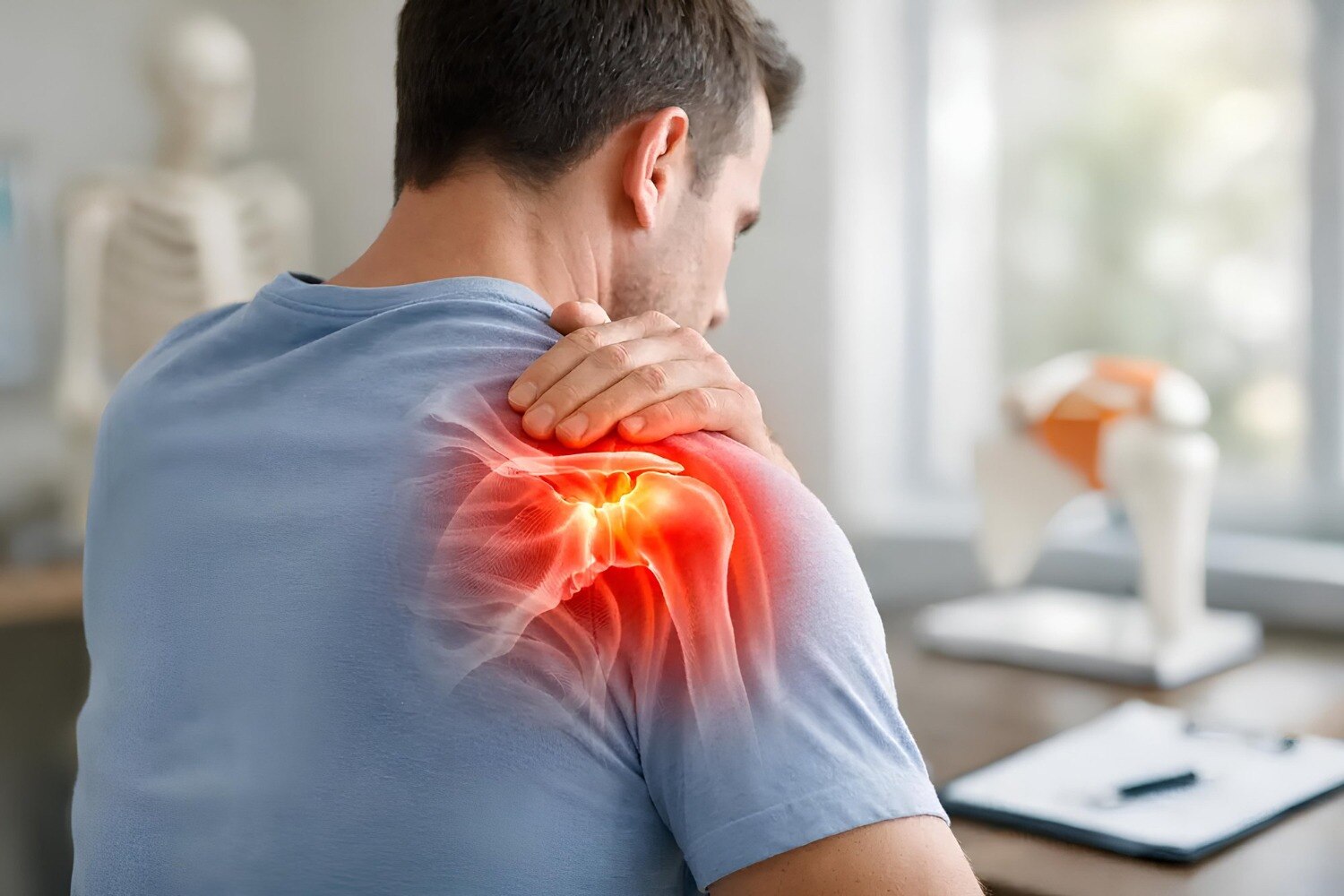
Rest can reduce the load on a painful shoulder without repairing a torn tendon, loosening a tight joint capsule, or treating pain that comes from the neck. By comparing your pain pattern with common shoulder and referred causes, you can identify when gentle movement is appropriate, when reassessment is needed, and which tests may clarify the source.
Key takeaways
- Rest reduces loading but cannot repair a torn tendon or damaged labrum.
- Night pain, weakness, catching, or instability can point to different shoulder problems.
- Neck nerves and upper-back problems can cause pain felt in the shoulder.
- Seek assessment when pain continues despite reduced activity or limits movement.
Why rest may not correct the cause of shoulder pain
Rest may reduce shoulder pain without correcting its cause. A rotator cuff tear, damaged labrum, instability, calcium deposit, or joint arthritis remains present after you stop lifting or playing sport. Rest lowers loading; it does not reattach a torn tendon, restore joint control, or replace worn cartilage.
| Problem | Why pain can continue after rest | Clues that need assessment |
|---|---|---|
| Rotator cuff tendinopathy or rotator cuff tear | Tendon injury still hurts with ordinary reaching, lying on that side, or at night; a full-thickness tear can also cause weakness. | Painful overhead movement, reduced strength, or inability to raise the arm |
| Subacromial bursitis | An inflamed bursa can remain sensitive after the original repetitive motion stops, especially if shoulder mechanics keep irritating it. | Pain in the outer shoulder during lifting or reaching across the body |
| Adhesive capsulitis (frozen shoulder) | The joint capsule tightens, so avoiding movement can increase stiffness rather than restore it. | Progressive loss of movement in several directions, including difficulty reaching behind your back |
| Shoulder osteoarthritis | Cartilage loss and bone changes remain even when activity is reduced. | Deep aching, stiffness, crepitus, and pain at rest |
| Instability or labral injury | Abnormal joint control or a tissue injury can cause catching, slipping, or pain without the original sport or lift. | Apprehension, clicking, or a feeling the shoulder may give way |
Calcific tendinitis is another exception: a calcium deposit in a rotator-cuff tendon can trigger intense pain at rest and at night. Imaging findings alone do not prove the cause, because tendinopathy and partial tears also occur without symptoms; examination and pain pattern must match.
What different pain patterns can reveal
Pain during overhead reaching, lying on the affected side, or night pain points toward rotator-cuff tendinopathy or bursitis. Weakness on lifting the arm, especially when pain limits normal use, raises concern for a rotator-cuff tear; rest cannot reattach a tendon separated from its bone.
The pattern matters more than pain intensity alone:
- Stiffness in several directions, particularly trouble reaching behind your back or lifting the arm overhead, fits adhesive capsulitis (frozen shoulder) more than an isolated tendon problem.
- Deep aching, reduced movement, grinding, or pain that increases after use suggests shoulder osteoarthritis. Pain focused on the top of the shoulder and aggravated by reaching across your chest points toward the acromioclavicular joint.
- Clicking, catching, a slipping sensation, or repeated episodes where the joint feels as if it may come out of place suggests a labral injury or “shoulder instability.” Stopping sport does not repair abnormal joint control or damaged labral tissue.
- Morning stiffness lasting longer than 30 minutes, pain in both shoulders, or swelling in other joints makes inflammatory arthritis, including rheumatoid arthritis, more likely than a local strain.
- Tingling, numbness, or pain travelling below the elbow points away from a purely shoulder-based problem. Neck movement that changes the pain suggests cervical radiculopathy or nerve compression.
A clinician can separate these patterns by comparing active and assisted movement, strength, joint stability, and neck responses. Persistent night pain, sudden loss of strength, or repeated slipping deserves assessment rather than prolonged rest.
When the pain may not be coming from the shoulder
Pain that changes with neck movement rather than shoulder activity points toward cervical radiculopathy. A pinched nerve in the neck can send pain into the shoulder, arm, or hand, with numbness and tingling, weakness, or pain below the elbow.
| Source | Clues that point away from a local shoulder disorder | What to do |
|---|---|---|
| Cervical radiculopathy | Neck turning, looking up, or prolonged sitting worsens pain; symptoms travel below the elbow | Arrange clinical assessment, especially for arm weakness or worsening sensation |
| Nerve compression | Burning or electric pain, numbness and tingling, reduced grip, or symptoms linked to elbow or wrist position | Seek assessment rather than repeatedly resting the shoulder |
| Cardiac or chest source | Pressure, breathlessness, sweating, nausea, or pain spreading to the jaw or arm; shoulder movement does not change it | Call emergency services immediately |
| Inflammatory disease | Both shoulders hurt, morning stiffness lasts longer than 30 minutes, or other joints are swollen | Request medical evaluation for inflammatory arthritis |
Pain referred from the upper back, acromioclavicular joint, or chest and abdominal organs can also be felt around the shoulder. Normal shoulder X-rays or an MRI do not rule out these sources. Get urgent help for new chest symptoms, faintness, severe breathlessness, or sudden neurological weakness.
How assessment and imaging identify the pain source
A clinician compares active and passive range of motion. Limited movement only when you move the arm suggests weakness or pain inhibition; restriction in both directions points toward adhesive capsulitis or arthritis. Strength testing helps separate a painful but functioning tendon from a rotator-cuff tear.
The examination also includes tenderness over the acromioclavicular joint and biceps tendon, shoulder-blade movement, and instability testing. Clicking, apprehension, or a slipping sensation can support instability or a labral problem, but no single manoeuvre proves the diagnosis.
A neck examination matters when pain travels below the elbow or comes with tingling, numbness, or weakness. Neck movement that reproduces the pain supports cervical radiculopathy, even when the shoulder itself feels tender.
Imaging helps when its findings match the examination and pain pattern:
- X-ray shows arthritis, joint-space loss, bone spurs, fractures, dislocation, or a calcium deposit. It cannot show most tendon tears.
- Ultrasound shows rotator-cuff tendons dynamically, including bursitis, tendinopathy, and many full-thickness tears. It also lets the examiner compare movement between shoulders.
- MRI shows the rotator cuff, labrum, cartilage, joint lining, bone marrow, and surrounding soft tissues. It helps when weakness persists, a labral injury is suspected, or surgery is being considered.
An abnormal scan is not automatically the pain source: tendinopathy and partial tears occur in people without symptoms. A normal shoulder scan also does not exclude pain from the neck, nerves, or another referred source.
What to do when pain continues after reducing activity
Replace the aggravating load, not all shoulder movement. Keep pain-limited movement within a comfortable range, use the arm for light tasks below shoulder height, and avoid painful overhead loading, heavy lifting, and repeated reaching. Complete immobilisation can increase stiffness and weakness.
- Set a reassessment timeframe of 7–14 days if pain is not clearly improving after activity modification.
- Arrange earlier review for increasing weakness, persistent night pain, catching, a slipping sensation, or difficulty lifting the arm.
- Seek urgent medical attention for a hot, swollen shoulder with fever, or for chest pressure, breathlessness, sweating, nausea, or pain spreading to the jaw or arm.
- Stop treating it as a local shoulder strain if tingling, numbness, or weakness travels from the neck into the arm, especially when neck movement changes the pain.
At Dhanvantari Hospital, an orthopaedic evaluation can test shoulder and neck movement, strength, stability, and nerve function before deciding whether an X-ray, ultrasound, or MRI is useful. That distinction matters: persistent weakness can point to a rotator-cuff tear, restricted movement to capsular stiffness or arthritis, and catching or instability to labral or joint-control problems.
The result may be a targeted rehabilitation plan, medication review, injection discussion, or surgical assessment rather than more unstructured rest.
Related services
Arthroscopy and Sports Medicine Treatment Arthroscopy and Sports Medicine Treatment At Dhanvantari Hospital, Dr. Anand Upadhye and Dr. Sushant Upadhye provides advanced Arthroscopy and Sports Medicine treatments for patients... View service → |
Back Pain And Joint Pain Clinic Back Pain And Joint Pain Clinic At Dhanvantari Hospital, Dr. Anand Upadhye and Dr. Sushant Upadhye offers specialized diagnosis and treatment for back pain, joint pain, neck pain,... View service → |
Frequently asked questions
Why can shoulder pain continue after rest and activity modification?
Rest lowers stress on the shoulder but does not repair a rotator cuff tear, labral injury, instability, calcium deposit, or arthritis.
What can shoulder pain patterns reveal?
Night pain, weakness, catching, instability, and pain linked to specific movements can help distinguish tendon, joint, and other shoulder problems.
Can pain felt in the shoulder come from the neck?
Yes. Neck nerves and upper-back problems can produce pain in the shoulder, sometimes with tingling, numbness, or arm weakness.
When should ongoing shoulder pain be assessed?
Arrange an assessment when pain continues after reducing activity, restricts movement, causes weakness, or interferes with sleep and daily tasks.