Back symptoms become a persistent spinal problem when they keep returning, limit walking, work, sleep or daily activities, or fail to improve with appropriate treatment—not simply because they hurt. By the end, you will know which symptoms need routine assessment, which require emergency care, how clinicians connect scans to examination findings, and when surgery has a defensible role.
Key takeaways
- Seek assessment for pain lasting weeks or limiting walking, work, sleep or daily tasks.
- Get emergency care for severe weakness, loss of bladder or bowel control, or saddle numbness.
- Try prescribed treatment, targeted exercise and rehabilitation before considering an operation.
- Surgery is considered when a specific spinal problem matches symptoms and non-surgical care has failed.
When spinal symptoms need assessment—or emergency care
Persistent back pain needs a routine spine evaluation when it lasts more than a few weeks, keeps returning, or fails to improve with sensible activity, exercise or prescribed treatment. Arrange assessment sooner when pain causes functional limitation, such as difficulty walking, working, sleeping or managing daily tasks.
Persistent pain alone does not establish a need for surgery.
Seek emergency care immediately for:
- New inability to urinate, urinary retention or loss of bladder control
- Loss of bowel control or new numbness around the genitals, buttocks or inner thighs
- Rapidly worsening leg weakness, new paralysis or a suddenly unsafe gait
- Severe back pain with fever, chills or feeling acutely unwell
- Severe pain after a major fall, crash or other significant trauma
| Pattern | Action | What it suggests |
|---|---|---|
| Persistent or recurrent pain without neurological loss | Book a routine spine evaluation | Requires examination and treatment planning, not automatic surgery |
| Pain with leg numbness, weakness or walking-related limitation | Arrange prompt clinical assessment | Possible nerve compression; imaging is considered when it could change treatment |
| Pain with fever, unexplained weight loss, previous cancer, immunosuppression or recent serious infection | Seek urgent medical assessment | Infection or cancer must be investigated |
| New bladder or bowel changes, saddle numbness or rapidly progressive weakness | Go to an emergency department now | Possible cauda equina compression |
A disc bulge, arthritis or a narrow canal on MRI does not by itself explain symptoms. Clinicians match the scan with your strength, reflexes, sensation, gait and symptom pattern before recommending treatment.
How clinicians determine whether the spine is causing your symptoms
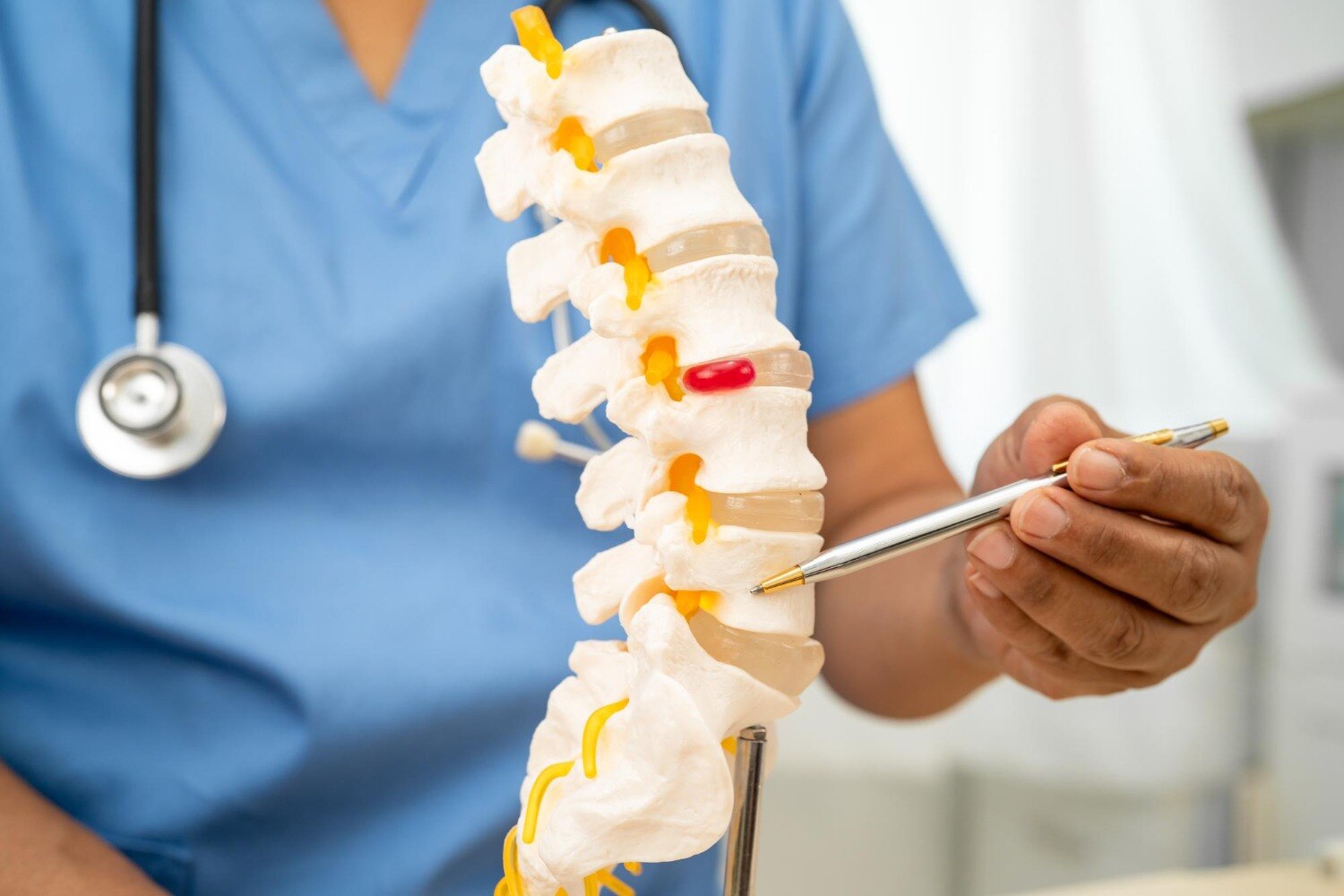
A spinal scan is clinically important only when its finding matches your symptoms, examination and daily limitations. Disc degeneration, bulging, protrusion and facet arthritis are common without pain, especially with age, so an abnormal image alone does not identify the pain source or justify surgery.
1. Start with the symptom pattern. Tell the clinician where pain travels, whether numbness or weakness follows a particular limb, what triggers it, and whether walking or standing worsens it. Leg pain, numbness or weakness relieved by sitting or bending forward fits lumbar stenosis more closely than back pain alone.
2. Have a neurological examination. Strength and reflex testing can reveal a nerve-root problem, while sensation testing checks whether numbness follows a recognised nerve distribution. A gait assessment may show foot drop, balance loss or weakness that an image cannot prove.
3. Match the examination to imaging. MRI for back pain is useful when serious disease is suspected, symptoms persist after assessment, or the result could change treatment. X-rays show alignment, fractures and some instability; CT gives clearer detail of bone and can help when MRI is unsuitable.
4. Compare the scan with the clinical findings and treatment response. A herniated disc beside a matching weak or painful nerve is more meaningful than an unrelated bulge. Persistent nonspecific back pain without a defined structural or neurological cause does not become a surgical indication simply because the MRI looks abnormal.
What to try before considering an operation
Try a defined course of conservative treatment before considering an operation, unless weakness is worsening or another urgent indication exists. The plan should match the diagnosis and include a review date, not continue indefinitely without measuring progress.
- Use structured physiotherapy to build strength, mobility and tolerance for walking or daily tasks.
- Apply activity modification: reduce movements that trigger leg pain, but avoid prolonged bed rest. Gradually resume useful activity.
- Take prescribed pain-relieving or anti-inflammatory medicines when safe for you, checking kidney, stomach, heart and other health risks.
- Consider an epidural steroid injection for acute, severe sciatica when a clinician confirms nerve-root irritation. It can reduce pain temporarily; it does not remove compression and is not a treatment for neurogenic claudication from central spinal stenosis.
- Add a combined physical and psychological programme for persistent nonspecific low-back pain when fear, low mood or pain-related avoidance limits recovery.
| Option | What it means | Evidence that it is working |
|---|---|---|
| Structured physiotherapy | Progressive exercises matched to your findings | You walk farther, move better, sleep more easily or need less medication |
| Activity modification | Change aggravating tasks without stopping all movement | Daily activities become possible with fewer flares |
| Injection or medication | Short-term symptom control | Pain reduction enables rehabilitation; relief alone does not prove the cause is corrected |
Reassess after the agreed programme using function, walking distance, sleep, pain interference and strength—not the MRI alone. If leg symptoms, weakness or disability remain substantial despite genuine participation, or neurological function declines, seek a spine review; if function improves enough for acceptable daily life, surgery may offer too little benefit to justify its risks.
The clinical problems that can justify spine surgery
A reasonable surgical case requires a confirmed structural problem that matches your symptoms and examination, not an abnormal scan by itself. The strongest indications involve nerve-root compression, spinal cord compression, progressive neurological loss, or mechanical instability.
| Condition | Findings that support surgery | Operation considered |
|---|---|---|
| Lumbar disc herniation | Radiating leg pain with matching weakness, sensory loss or reflex change that remains severe despite non-operative care | Discectomy |
| Lumbar spinal stenosis | Leg pain, numbness or weakness triggered by standing or walking, relieved by sitting or bending forward, with persistent disability or worsening weakness | Decompression |
| Cervical myelopathy | Clumsy hands, loss of fine motor control, balance or gait problems, increased reflexes, or other signs of spinal cord compression | Cervical decompression, sometimes with fusion |
| Unstable fracture or deformity | Loss of alignment, ligament or bone disruption, neural compression, or neurological deficit | Stabilisation, decompression, or both |
| Symptomatic spondylolisthesis | Vertebral slippage causing nerve symptoms or instability that persists after appropriate treatment | Decompression with selective fusion |
Moderate or severe degenerative cervical myelopathy usually warrants surgery. In mild disease, close monitoring and structured rehabilitation can be considered, but worsening strength, coordination, walking or bladder function changes the decision.
Fusion is not a routine addition to decompression for uncomplicated lumbar stenosis. It is considered when decompression would destabilise the spine or when clinically important instability, deformity or selected spondylolisthesis exists.
Persistent back pain alone does not justify surgery. A disc bulge or degenerative change without matching neurological or mechanical findings is not an indication for discectomy, decompression or fusion.
When surgery is the wrong choice—and how to make the decision
Avoid surgery when you have nonspecific low-back pain without matching nerve symptoms, progressive weakness, spinal instability, deformity or another defined structural problem. NICE advises against spinal fusion and disc replacement for this pattern outside a clinical trial. Pain lasting months does not, by itself, create an operation indication.
Do not let an MRI report make the decision. Disc bulges, degeneration and facet arthritis are common without pain; operating on an incidental finding exposes you to complications without treating the cause. For spinal stenosis, leg pain, numbness or weakness triggered by standing or walking carries more weight than back pain alone.
Before agreeing to an operation, ask these questions during a spine surgery consultation:
- What exact diagnosis explains my symptoms, and which examination findings support it?
- Does the scan abnormality match my pain, weakness, reflex changes or walking limitation?
- What is the operation intended to improve: leg pain, strength, walking distance or back pain?
- What non-surgical options remain, and what result would count as failure?
- Why do I need spinal fusion rather than decompression alone? Is there documented spinal instability, deformity or a risk that decompression will create instability?
- What are the major risks, recovery restrictions, chance of repeat surgery and likely outcome without surgery?
- What happens if I wait, and would a second opinion change the plan?
At Dhanvantari Hospital, asking these questions helps you use orthopaedic spine expertise to test whether surgery fits the diagnosis rather than treating an alarming scan.
Related service
Spine Surgery Treatment At Dhanvantari Hospital, Dr. Anand Upadhye and Dr. Sushant Upadhye provides advanced and specialized Spine Surgery Treatment for patients suffering... View service → |
Frequently asked questions
When should persistent spinal symptoms be assessed?
Arrange a spine evaluation when symptoms last more than a few weeks, keep returning, or limit walking, work, sleep or daily tasks.
When do spinal symptoms require emergency care?
Seek emergency care for severe or worsening weakness, loss of bladder or bowel control, or numbness around the inner thighs and groin.
What do clinicians check before recommending spine surgery?
They compare your symptoms and examination findings with imaging and assess whether a specific spinal problem explains the functional limitation.
What should you try before considering spine surgery?
Treatment may include activity changes, prescribed medicines, targeted exercise, physiotherapy and rehabilitation, based on the cause and your health.
When is spine surgery the wrong choice?
Surgery is the wrong choice when imaging does not match your symptoms, non-operative options have not been tried when appropriate, or expected benefits do not outweigh the risks.