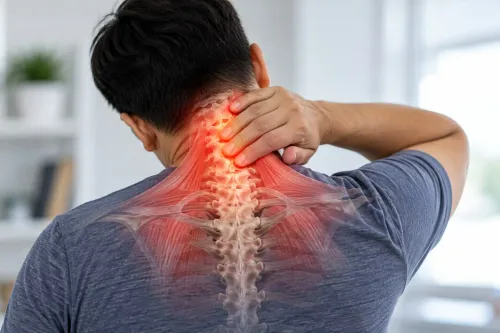

Neck pain lasting longer than 12 weeks, returning repeatedly, or gradually limiting sleep, work, or arm function deserves more than repeated self-treatment. By the end, you will be able to match common symptoms to possible causes, recognise emergency warning signs, and choose between home care, prompt review, and routine medical assessment.
Key takeaways
- Neck pain lasting beyond 12 weeks needs medical assessment.
- Weakness, numbness, balance problems, or bladder changes require prompt care.
- Seek emergency help after neck pain with major injury, fever, or sudden neurological symptoms.
- Use gentle movement and avoid prolonged bed rest during the first few days.
What Counts as Persistent Neck Pain, and What Can Cause It?
A practical persistent neck pain definition is symptoms lasting beyond 12 weeks. It also includes pain that continues past the expected recovery period, repeatedly returns, or progressively restricts movement, sleep, work, or arm use. Those patterns warrant medical assessment rather than repeated self-treatment alone.
Common causes include:
- Neck muscle strain or ligament strain after overuse, awkward sleep, lifting, or sudden movement.
- Prolonged screen posture or phone posture, especially when your head stays bent forward for hours.
- Cervical spondylosis, the age-related wear affecting discs and joints.
- Facet-joint pain, which often worsens when you extend or rotate your neck.
- Whiplash after a sudden acceleration-and-deceleration injury.
- Cervical radiculopathy, when disc irritation or another narrowing affects a nerve root and sends pain, tingling, numbness, or weakness into the shoulder or arm.
- Spinal stenosis, where reduced space around the spinal cord or nerve roots causes symptoms that need examination.
- Inflammatory arthritis, infection, or fracture, which require prompt clinical assessment.
- Referred pain from another area, such as the shoulder, chest, or upper back.
A scan does not automatically identify the cause. Disc narrowing, osteophytes, and disc bulges commonly appear in people without pain, so an abnormal result must match your symptoms and examination before it explains them.
Which Symptoms Point to a Muscle, Joint, Nerve, or Spinal-Cord Problem?
A local ache, tightness, tenderness, reduced movement, or pain triggered by turning or holding one position fits muscle, ligament, facet-joint, or other mechanical pain more closely. The symptom pattern matters:
| Symptoms | More likely source | What to do |
|---|---|---|
| Local neck ache, stiffness, tenderness, reduced range of motion | Muscle strain, ligament irritation, facet-joint pain, posture-related mechanical pain | Arrange routine review if it persists, recurs, or worsens |
| Neck pain radiating to arm, with numbness and tingling, altered reflexes, or arm weakness | Cervical radiculopathy from irritation or compression of a nerve root | Seek medical assessment, especially for new or worsening weakness |
| Loss of hand dexterity, dropping objects, clumsy handwriting, leg stiffness, exaggerated reflexes, unsteady walking, or balance problems | Cervical spinal-cord dysfunction, called myelopathy | Obtain prompt specialist assessment; deterioration can become irreversible |
| Headache beginning in the neck and worsened by neck movement | Cervicogenic headache linked to neck joints or muscles | Arrange review if recurrent or disabling |
A neck pain headache is not automatically dangerous, but a severe, sudden, or unusual headache with facial drooping, one-sided weakness or numbness, speech or vision changes, severe dizziness, or imbalance requires emergency care. Call emergency services, particularly after neck trauma or manipulation, rather than driving yourself.
New neck weakness or progressive arm or leg symptoms also need prompt assessment.
When Is Neck Pain an Emergency, Urgent Problem, or Routine Concern?
Call emergency services rather than driving yourself when neck pain comes with any of these neck pain emergency warning signs:
- Neck pain after a major fall or collision, especially with inability to move safely, altered alertness, midline tenderness, or limb weakness or numbness. Keep the neck still while help arrives.
- Sudden severe neck pain or headache with facial drooping, one-sided weakness, speech or vision changes, severe dizziness, or imbalance.
- Chest pressure, breathlessness, sweating, nausea, or pain spreading to the jaw or arm.
- Severe stiffness with fever and stiff neck, vomiting, confusion, light sensitivity, or a rash.
Arrange urgent medical assessment for new or worsening weakness, loss of hand coordination, dropping objects, difficulty walking, or bladder or bowel changes. These symptoms can indicate spinal-cord involvement, and neurological damage can become permanent.
Seek prompt assessment for fever or chills, unexplained weight loss, a history of cancer, immune suppression, a recent infection, or severe unremitting night pain. Do not treat these features as an ordinary muscle strain.
Routine medical review fits persistent, recurrent, or gradually worsening neck pain without red flags. Book an appointment if pain continues to limit sleep, work, movement, or arm use, even when you have no emergency symptom. A clinician can examine the cause and decide whether treatment, monitoring, or imaging is appropriate.
What Can You Safely Do During the First Few Days?
If you have no red-flag symptoms, keep moving during the neck pain first few days. Reduce activities that clearly increase pain, change your screen height and position frequently, and walk or continue tolerable daily tasks instead of staying in bed.
Heat versus cold for neck pain depends on timing and response:
| Option | How to use it | Best fit |
|---|---|---|
| Cold pack | Wrap it in cloth and use a short session | First day or two after a fresh strain, if it eases pain |
| Heat pack | Wrap it in cloth and use a short session | Later in recovery, or whenever warmth relaxes muscle spasm |
| Neither | Stop if skin becomes painful, numb, or irritated | When the pack worsens symptoms |
Sleep on your back or side, keeping your neck level rather than twisted. For sleep position and pillow choice, use a pillow that fills the gap between your neck and mattress without pushing your head upward; avoid sleeping face-down.
Try gentle neck turns and nods within a comfortable range. Do not force through sharp pain.
- Avoid heavy lifting, high-impact exercise, forceful stretching, and neck manipulation.
- Do not wear a cervical collar continuously unless a clinician directs you; unnecessary immobilisation can increase stiffness and weakness.
For neck pain medication safety, ask a clinician or pharmacist before taking ibuprofen, naproxen, paracetamol, or a muscle relaxant if you have ulcers, kidney or liver disease, take blood thinners, are pregnant, or use medicines with interaction risks. Do not combine products or improvise doses.
What Will a Medical Assessment Check, and When Is Imaging Needed?
If self-care has not worked, the assessment starts with when the pain began, any fall or collision, work and screen exposure, fever, recent infection, cancer history, immune suppression, and night pain. The clinician will map pain into the shoulder or arm and ask about tingling, numbness, weakness, balance, and hand control.
A neck pain examination checks neck movement and tenderness, arm and leg strength, sensation, reflexes, gait, and hand coordination. New weakness, clumsy hands, or an unsteady walk needs prompt specialist review.
After trauma, clinicians use the Canadian C-spine rule and NEXUS criteria to decide whether cervical spine imaging is needed. These tools do not replace emergency care after a high-impact injury or when you cannot move safely.
Imaging choice depends on the presentation:
| Option | What it shows | When it applies |
|---|---|---|
| No immediate advanced imaging | Clinical findings guide initial care | New nontraumatic pain without red flags |
| Cervical radiographs | Alignment, fracture, and degenerative change | Selected uncomplicated cases or suspected bony injury |
| MRI for neck pain | Discs, nerves, spinal cord, infection, and tumours | Suspected infection, malignancy, cord involvement, persistent radicular symptoms, or neurological findings |
Surgery is considered for progressive motor loss, myelopathy, instability, or a structural lesion matching your symptoms after appropriate nonsurgical care. A scan finding alone is not a reason for surgery; cervical radiculopathy treatment often begins without an operation.
In Panvel, Dhanvantari Hospital is one option for orthopaedic assessment when symptoms need review. Emergency symptoms require emergency services, not a routine appointment.
Related services
Back Pain And Joint Pain Clinic Back Pain And Joint Pain Clinic At Dhanvantari Hospital, Dr. Anand Upadhye and Dr. Sushant Upadhye offers specialized diagnosis and treatment for back pain, joint pain, neck pain,... View service → |
Spine Surgery Treatment At Dhanvantari Hospital, Dr. Anand Upadhye and Dr. Sushant Upadhye provides advanced and specialized Spine Surgery Treatment for patients suffering... View service → |
Frequently asked questions
What counts as persistent neck pain?
Neck pain is persistent when it lasts beyond 12 weeks, exceeds expected recovery, repeatedly returns, or increasingly limits movement, sleep, work, or arm use.
Which symptoms suggest a nerve or spinal-cord problem?
Pain radiating into an arm, tingling, numbness, weakness, clumsy hands, balance trouble, or changes in bladder or bowel control can indicate nerve or spinal-cord involvement.
When is neck pain an emergency?
Seek emergency care after a major injury or when neck pain occurs with sudden weakness, severe numbness, difficulty walking, loss of bladder or bowel control, fever, or confusion.
When is imaging needed for neck pain?
A clinician considers imaging after an examination when symptoms persist, follow a significant injury, suggest nerve or spinal-cord involvement, or raise concern about infection, fracture, or another serious cause.