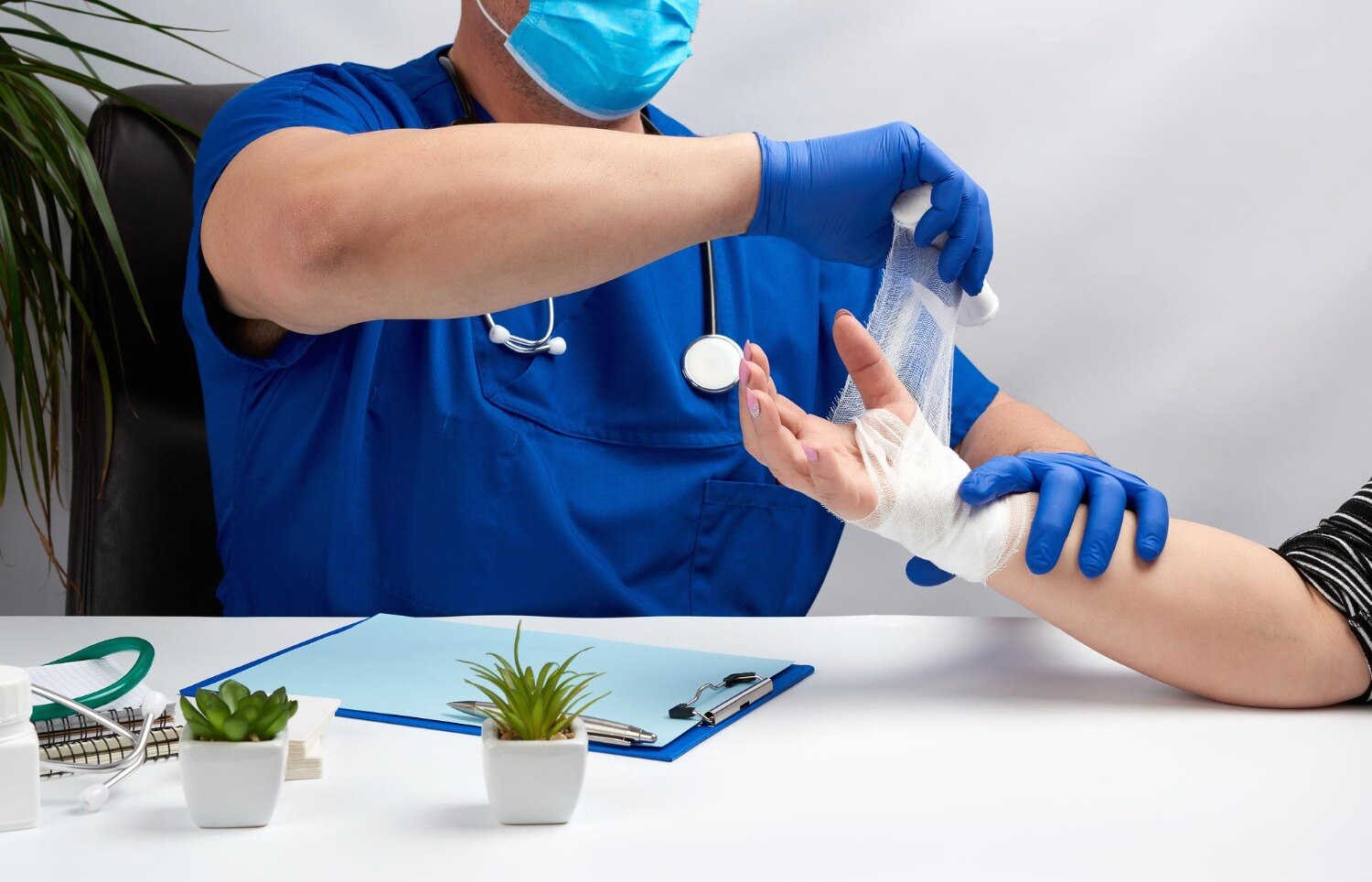
A fracture needs emergency care when it threatens blood flow, nerve function, the skin, breathing, or the stability of the spine or pelvis. By the end, you will know which signs call for an ambulance, what to do while help is coming, and when a suspected fracture needs same-day or prompt orthopaedic assessment.
Key takeaways
- Call emergency services for severe bleeding, absent pulses, numbness, or an open fracture.
- Keep the injured area still and support it above and below the suspected break.
- Do not move suspected spine, pelvis, or multiple-fracture injuries unless danger demands it.
- Arrange prompt assessment for seemingly minor wrist, hip, hand, or stress fractures.
Which fracture signs mean you should call emergency services now?
Call emergency services immediately if a fracture threatens blood flow, nerve function, skin, or the person’s overall stability. Do not wait for a routine appointment when any of these signs appears:
| Sign | Why it needs ambulance-level care |
|---|---|
| Open fracture: bone through skin or a wound communicating with the fracture | Requires hospital treatment, intravenous antibiotics, and surgical wound cleaning, not outpatient scheduling |
| Uncontrolled bleeding | May indicate major vessel damage or shock |
| Blue or pale limb, unusual coldness, absent pulse, or new numbness | Signals threatened circulation or nerve injury |
| Severe swelling with rapidly worsening or disproportionate pain | May indicate dangerous pressure building inside the limb |
| Obvious deformity or dislocation | Reduction may be needed urgently, but home manipulation can worsen damage |
| Inability to move fingers or toes, new weakness, or loss of sensation | Suggests nerve or blood-supply compromise |
A normal pulse does not rule out compartment syndrome. Escalating pain, tight swelling, pain when the affected muscles are gently stretched, or altered sensation still demands emergency assessment, even when the pulse feels normal.
Leave a visibly deformed limb in the position you found it and support it without forcing movement. Straightening it at home can tear skin, blood vessels, nerves, and other soft tissue, or convert a closed injury into an open fracture. Cover exposed bone with a clean dressing, but never push it back under the skin.
What should you do before medical help arrives?
1. Keep the person still and support the injured limb in its current position. Do not straighten a deformity, push protruding bone beneath the skin, test the injury by moving it, massage the area, or repeatedly inspect the wound.
2. Remove rings, watches, bracelets, shoes, and tight clothing before swelling increases. For fracture first aid, cover an open wound with a sterile dressing or clean cloth. If bleeding continues, apply pressure around the protruding bone, never directly over it.
3. Use wrapped ice for short periods to limit swelling. Never place ice on bare skin or on skin that is numb, pale, or cold.
4. Before splinting, record whether each finger or toe moves, its skin colour and temperature, and any numbness or tingling. After splinting, check the same signs against the uninjured side; loosen the splint if fingers or toes become bluer, paler, colder, more numb, weaker, or harder to move.
A splint must support the limb without worsening circulation or sensation.
5. Do not give food or drink if surgery or sedation may be needed. Call emergency services for an open fracture, uncontrolled bleeding, threatened circulation, or suspected spine injury, and follow the dispatcher’s instructions rather than moving the person unnecessarily.
Record the injury time, how it happened, medicines, and any change in pain, colour, temperature, movement, or sensation for the treating team.
When should you avoid moving someone with a suspected spine, pelvis, or multiple fracture?
Keep a person still and call emergency services if a spinal fracture is possible. This is especially urgent with neck or back pain, limb weakness, numbness, poor balance, or new bladder or bowel problems; unnecessary movement can worsen an unstable spinal injury.
After a high-energy impact, treat a pelvic fracture as an ambulance emergency. Internal bleeding can occur without an open wound. Watch for:
- Faintness, confusion, pallor, rapid breathing, abdominal pain, or worsening weakness
- Shock, heavy blood loss, or increasing drowsiness
- Pain in the pelvis, inability to stand safely, or multiple fractures
Do not let the injured person walk or travel privately when shock or spinal injury is possible. Request ambulance transport for pelvic injury, suspected spinal instability, multiple fractures, or any injury with heavy blood loss.
Head injury, loss of consciousness, breathing difficulty, chest pain, or abdominal trauma changes the priority from isolated fracture care to emergency assessment. Keep the person in the position found unless they are in immediate danger, and avoid twisting the neck, back, or pelvis while waiting for responders.
When is a fracture a same-day emergency, a 24-hour review, or a routine appointment?
Use the highest-risk category that fits, not the least painful one. A fracture does not automatically need emergency surgery, but the wrong delay can cost skin, blood supply, nerve function, or life.
| Level | Go where | Use it when |
|---|---|---|
| Ambulance-level emergency | Call emergency services | Open fracture, threatened circulation, suspected compartment syndrome, severe bleeding, major deformity or dislocation, spinal or pelvic instability, or head, chest, or abdominal injury |
| Same-day emergency department | Attend today | Painful suspected fracture, inability to bear weight, significant swelling, dislocation, or a limb that cannot be used even with intact circulation |
| Within 24 hours | Arrange urgent orthopaedic review | Suspected fracture that is stable, closed, and free of red flags |
| Routine appointment | Book planned follow-up | A stable, closed, well-aligned injury has already been assessed and immobilised |
In Panvel, Dhanvantari Hospital can be a local option for orthopaedic or trauma assessment, but emergency services take priority for life-threatening signs.
Treat suspected hip fracture in older adults as a hospital emergency even if the person can still move the leg. Once medically safe, surgery is commonly considered on the day of admission or the following day; correctable problems such as dehydration, anaemia, anticoagulation, or heart failure should not turn into home management.
Which fractures can look minor but still need prompt assessment?
Persistent hip pain and inability to bear weight after a fall require reassessment, even after a normal X-ray. An occult fracture can remain hidden on the first film.
| Presentation | What not to dismiss | Prompt action |
|---|---|---|
| Hip pain after a fall | Ongoing focal pain and inability to bear weight can indicate a hidden hip fracture. | Arrange MRI. Consider CT when MRI is unavailable within 24 hours or contraindicated. |
| Child refusing to use a limb | A growth-plate fracture near the wrist, elbow, knee, or ankle may look like a bruise. Later growth arrest or angular deformity can result. | Arrange prompt orthopaedic assessment, even without obvious deformity. |
| Wrist pain after a fall | Tenderness in the anatomical snuffbox or directly over the scaphoid suggests a scaphoid fracture, which initial X-rays can miss. | Immobilise the wrist and obtain repeat or advanced imaging. Continued use risks non-union and later arthritis. |
Compartment syndrome is different and demands emergency care: escalating pain, tight swelling, pain on gentle muscle stretch, or altered sensation can signal rising pressure. A present pulse does not exclude it; pulse loss is a late finding.
What should you monitor while waiting or after a temporary splint?
Record the injury time and each circulation check. Note pain trend, skin colour, skin temperature, numbness or tingling, and sensation and movement in each finger or toe. Compare the injured side with the uninjured side before and after applying a temporary splint.
| Check | Injured side before | Uninjured side | Injured side after |
|---|---|---|---|
| Pain | Score and trend | Compare | Score and trend |
| Colour and temperature | Note changes | Compare | Note changes |
| Sensation and movement | Test each digit | Test each digit | Retest each digit |
| Swelling | Note size and speed | Compare | Note changes |
Escalate immediately if fingers or toes become blue, pale, cold, increasingly numb, weaker, or impossible to move; swelling rapidly increases; or pain becomes severe despite keeping the limb still.
A fracture does not automatically require emergency surgery. Urgency depends on skin damage, blood supply, nerve function, compartment pressure, deformity, associated injuries, and overall condition. Give the treating team the injury time, mechanism, medications including anticoagulants, medical conditions, and any circulation changes.
Frequently asked questions
Which fracture signs mean you should call emergency services now?
Call immediately for uncontrolled bleeding, exposed bone, severe deformity, cold or blue skin, absent pulse, new numbness or weakness, breathing trouble, loss of consciousness, or signs of shock.
What should you do before medical help arrives?
Keep the person still, control bleeding with clean pressure around—not over—an exposed bone, support the injury above and below, apply a wrapped cold pack, and avoid food or drink in case surgery is needed.
When should you avoid moving someone with a suspected spine, pelvis, or multiple fracture?
Do not move them when a spine, pelvis, or multiple fracture is suspected unless fire, traffic, collapse, or another immediate danger requires movement. Keep the head, neck, and torso aligned while waiting for help.
When is a fracture a same-day emergency, a 24-hour review, or a routine appointment?
Use emergency services for threats to breathing, circulation, nerves, skin, or consciousness. Seek same-day care for significant pain, deformity, inability to bear weight, or a suspected open fracture; arrange review within 24 hours for a stable suspected fracture, and book routine care only when a clinician has ruled out urgent injury.